


 EN
EN RU
RU ES
ES 中文
中文 DE
DE EL
EL IT
IT JA
JA KO
KO PT
PT ID
ID SR
SR UK
UK VI
VI TH
TH TR
TR MS
MS BE
BE AR
ARPractical Guide on Technological Innovation and Scenario-Based Application of Decentralized Wastewater Treatment Equipment
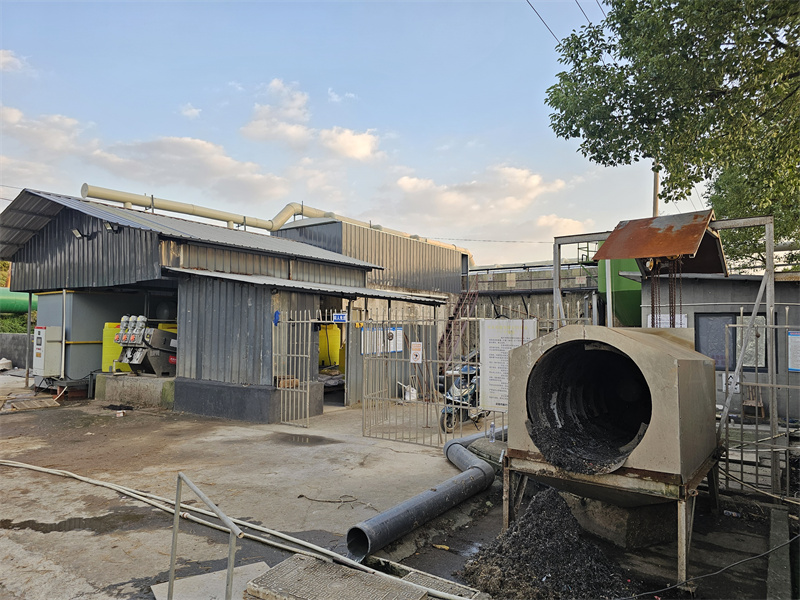
Driven by both rural living environment improvement and zero-waste city construction, decentralized sewage treatment equipment has evolved from supplementary governance tools into core facilities for ecological protection. Compared with centralized sewage systems, decentralized units feature on-site treatment, flexible adaptability and low O&M costs, effectively solving wastewater treatment problems in villages, scenic spots, remote towns and other scattered areas. This paper focuses on technical upgrading directions, scenario-specific solutions, equipment selection decision systems and O&M optimization strategies of decentralized sewage treatment equipment, delivering professional and implementable implementation paths for wastewater governance.
I. Governance Pain Points of Decentralized Sewage & Technical Breakthroughs of Equipment
Due to scattered sources and complex components of decentralized wastewater, traditional treatment equipment often struggles with hard compliance, complicated maintenance and high costs, which drives continuous technical innovation:
Analysis of Core Governance Pain Points
Severe fluctuations in water volume and quality: Affected by seasonal population migration, daily water flow in rural areas can swing 3–5 times. In catering-concentrated zones, COD fluctuates widely from 500 to 3000mg/L, making equipment with fixed parameters hard to operate stably.
Complex mixed pollutants: Mixture of domestic sewage, breeding wastewater and catering sewage creates composite pollution featuring high organics, high ammonia nitrogen and high suspended solids. Ammonia nitrogen often hits 50–100mg/L and total phosphorus exceeds 1–3mg/L, which cannot be fully removed by a single process.
Severe shortage of professional O&M resources: Over 90% of rural regions lack dedicated maintenance staff. Equipment breakdowns take 7–15 days to repair, and many units become idle "ornamental projects" with an operation rate below 60% due to improper upkeep.
Strict ecological bearing requirements: Most decentralized effluent discharges directly into surrounding water bodies or farmland, which must meet Grade I limits specified in the Discharge Standard of Water Pollutants for Rural Domestic Sewage Treatment Facilities (COD≤50mg/L, ammonia nitrogen≤8mg/L, total phosphorus≤0.5mg/L), with stricter standards applied in ecologically sensitive zones.
Three Major Technical Innovations of Equipment
Shock load resistance technology: New-generation equipment adopts dynamic regulation and buffer design. Equipped with variable-frequency aeration and intelligent recirculation, it maintains stable treatment performance under ±80% flow fluctuation and ±100% COD fluctuation, solving the crash risk of conventional equipment under overload.
Low-carbon high-efficiency processes: Combined low-carbon processes such as anammox + constructed wetland and photovoltaic-driven aeration cut energy consumption by 40–60% versus traditional equipment, with running costs controlled at 0.5–1 RMB per ton of water to fit rural economic conditions.
Intelligent O&M system: Integrated IoT sensors and AI algorithms realize real-time water quality monitoring, automatic fault early warning and remote diagnosis. Maintenance response time is shortened within 24 hours, and non-professional operators can master operation after simple training.
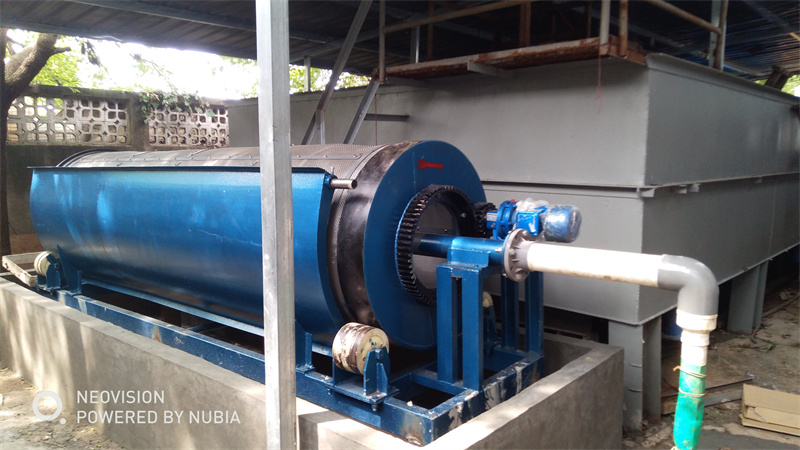
II. Mainstream Technologies of Decentralized Sewage Treatment Equipment & Scenario Adaptation
Differentiated technical solutions shall be matched according to wastewater characteristics of various scenarios. Main equipment types and applicable fields are listed as below:
Biological Treatment Equipment: Efficient Organic Pollutant Degradation
Biological technology removes pollutants via microbial metabolism, serving as the primary choice for decentralized sewage treatment:
Integrated MBBR Equipment
Technical Features: Synergistic effect of suspended carriers (specific surface area ≥600㎡/m³) and activated sludge; COD removal rate 85–90%, ammonia nitrogen removal rate 80–90%, excellent shock resistance.
Applicable Scenarios: Centralized village treatment (10–100 tons/day), township domestic sewage, especially sites with volatile water quality.
Economic Indicators: Investment 2000–3500 RMB per ton per day, operation cost 0.6–1.2 RMB/ton, service life over 15 years.
Buried A²/O Equipment
Technical Features: Integrated anaerobic, anoxic and aerobic zones to simultaneously remove nitrogen and phosphorus; total nitrogen removal 70–80%, total phosphorus removal 60–70%; buried installation occupies no ground surface.
Applicable Scenarios: Ecologically sensitive areas, surroundings of scenic spots (5–50 tons/day) with high landscape requirements.
Economic Indicators: Investment 2500–4000 RMB per ton per day, operation cost 0.8–1.5 RMB/ton; sludge cleaning required 1–2 times annually.
Ecological Treatment Equipment: Low-Cost & Sustainable
Ecological technology relies on natural purification capacity, ideal for regions with abundant land resources:
Composite Constructed Wetland System
Technical Features: Combined subsurface flow + surface flow wetland; aquatic plants (calamus, canna) cooperate with microbes; COD removal 65–75%, total phosphorus removal 75–85%, nearly zero energy consumption.
Applicable Scenarios: Single-village decentralized treatment (5–30 tons/day), sewage near farmland, areas with low land cost.
Economic Indicators: Investment 1500–2500 RMB per ton per day, operation cost 0.1–0.3 RMB/ton; annual plant harvesting required.
Stabilization Pond & Percolation System
Technical Features: Anaerobic pond pre-treatment reduces organic load, followed by soil percolation for advanced purification; suitable for high-concentration breeding wastewater with ammonia nitrogen removal over 70%.
Applicable Scenarios: Breeding clusters, remote villages (3–20 tons/day), better performance in warm climate zones.
Economic Indicators: Investment 1000–2000 RMB per ton per day, operation cost ≤0.2 RMB/ton, large land occupation (2–5㎡ per ton daily capacity).
Integrated Intelligent Equipment: Precise Control & Easy Maintenance
High integration intelligent units fit sites lacking professional maintenance teams:
Small Intelligent Purification Tank
Technical Features: Modular design integrating pre-treatment, biological reaction, sedimentation and disinfection; PLC system automatically adjusts operating parameters, supporting mobile APP remote monitoring, single unit capacity 0.5–5 tons/day.
Applicable Scenarios: Single-household & joint-household rural sewage, scattered mountain residences.
Economic Indicators: Investment 3000–5000 RMB per ton per day, operation cost 0.3–0.8 RMB/ton, maintenance cycle 3–6 months.
Mobile Emergency Treatment Equipment
Technical Features: Vehicle-mounted design adopting coagulation + membrane filtration + disinfection process, rapidly deployable to temporary drainage points such as festival events and construction sites, capacity 5–50 tons/day.
Applicable Scenarios: Temporary capacity expansion in peak tourist seasons, emergency sewage treatment demands.
Economic Indicators: Rental fee 2000–5000 RMB/day, treatment cost 1.5–3 RMB/ton, installation & commissioning finished within 24 hours.
III. Decision-Making System for Decentralized Sewage Treatment Equipment Selection
Scientific procurement requires a data-driven and scenario-matching decision workflow to avoid blind purchase:
Core Pre-Selection Investigation Items
Water quality testing: Collect three consecutive sewage samples to test COD, BOD, ammonia nitrogen, total phosphorus, SS and other indicators, identify characteristic pollutants (breeding wastewater, catering grease etc.) and form a formal water quality report. For example, breeding zones focus on ammonia and phosphorus removal while scenic spots strengthen suspended solid treatment.
Water volume calculation: Determine design flow based on permanent population, daily water quota (100–150L per capita per day) and floating population coefficient (×2–3 for peak tourist seasons). Equipment capacity shall be set as average daily flow ×1.3 to reserve buffer space for shock loads.
Site assessment: Measure available land area, terrain gradient, groundwater level and frozen soil depth. Equipment in northern cold regions shall be buried below frozen soil (≥1.2m), and anti-landslide design adopted for mountainous areas.
Evaluation of Key Selection Indicators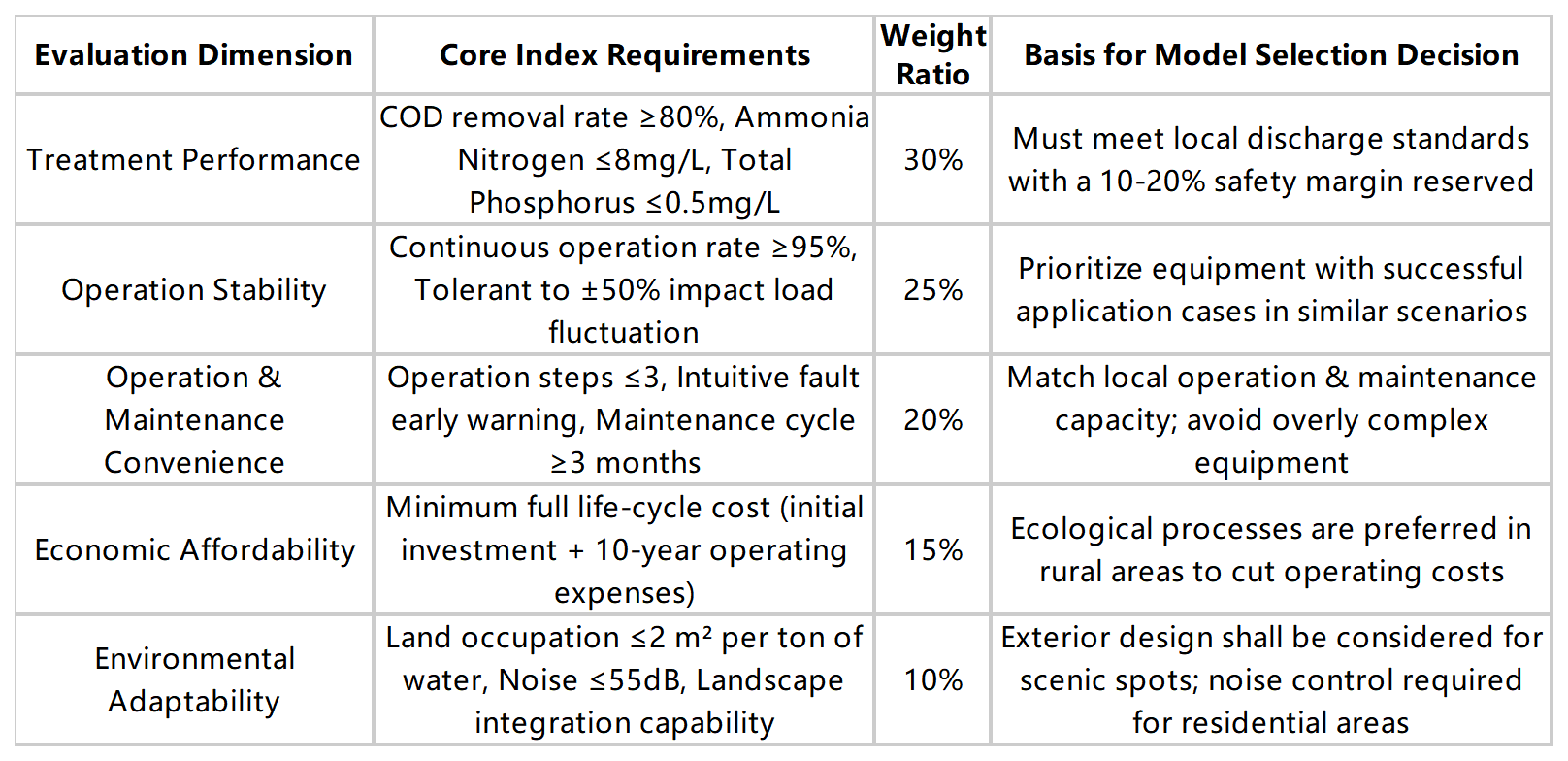
Recommended Selection Schemes for Typical Scenarios
Ordinary rural village (50 tons/day): Combined process of bar screen + equalization tank + MBBR equipment + constructed wetland; total investment around 120,000–180,000 RMB, operation cost 0.6–0.9 RMB/ton, meeting Grade B discharge standard with simple maintenance.
Ecologically sensitive zone (30 tons/day): Pre-treatment + buried A²/O + advanced nitrogen & phosphorus removal system; total investment around 150,000–220,000 RMB, operation cost 0.9–1.3 RMB/ton, ensuring total phosphorus ≤0.3mg/L to protect surrounding water bodies.
Tourist scenic spot (100 tons/day): Microfilter + equalization tank + intelligent MBR + water reuse system; total investment around 350,000–500,000 RMB, operation cost 1.2–1.8 RMB/ton; reclaimed water for green irrigation cuts fresh water consumption by 50%.
Remote single household (1 ton/day): Small intelligent purification tank; total investment around 8,000–12,000 RMB, operation cost 0.3–0.5 RMB/ton, remote mobile monitoring with quarterly maintenance only.
IV. Equipment O&M Optimization & Policy Support
Long-term stable operation of decentralized sewage treatment equipment relies on standardized management and policy guarantees:
Standardized O&M Management Workflow
Daily operation: Check operating status (liquid level, aeration volume, effluent residual chlorine) via equipment control panel and record key parameters every day; clean screen residues and inspect pipeline leakage weekly.
Periodic maintenance: Inspect aeration uniformity and clean filters monthly; calibrate online water quality analyzers and supplement microbial nutrients for biological equipment quarterly; replace wearing parts such as sealing rings and disinfection lamps annually.
Intelligent upgrading: Equip units with IoT modules to realize remote monitoring and fault early warning. Build regional O&M centers adopting the "1 center + multiple stations" mode to lower maintenance costs and improve response efficiency.
Practical Cost Control Tips
Energy optimization: Install photovoltaic power supply for small-scale equipment to reduce electricity bills; fit variable-frequency blowers on large units to automatically adjust rotation speed according to dissolved oxygen, saving 20–30% power consumption.
Chemical saving: Precisely control phosphorus remover and disinfectant dosage via online monitors to avoid over-dosing; regularly add high-efficiency strains to biological systems to cut nutrient consumption by over 30%.
Innovative O&M mode: Promote joint maintenance by equipment manufacturers and village collectives. Manufacturers provide technical support and periodic upkeep while village staff conduct daily patrols, reducing overall O&M costs by 20–40%.
Policy Dividends & Application Guidelines
Financial subsidies: Central rural environmental improvement funds cover 30–50% of investment on decentralized sewage treatment equipment, with an extra 10–20% bonus for demonstration projects in some provinces.
Tax incentives: Purchases of environmental equipment enjoy VAT refund upon collection and the three-year tax exemption plus three-year half reduction policy for corporate income tax, easing upfront capital pressure.
Application tips: Project application documents shall highlight technical innovations (intelligent O&M, low-carbon processes), ecological benefits (COD emission reduction, reclaimed water volume) and demonstration effects, attached with complete water quality test reports and cost calculation sheets.
Technical advancement and scenario-based application of decentralized sewage treatment equipment are reshaping the landscape of rural wastewater governance. Accurate equipment selection, intelligent operation and favorable policy support can simultaneously achieve stable compliant discharge and lower governance costs, delivering solid backing for rural revitalization and ecological conservation. Relevant institutions are recommended to entrust professional organizations to conduct feasibility studies before project implementation and select matched technical solutions based on local actual conditions, maximizing the return of every environmental investment and driving the transformation of decentralized sewage governance from quantity coverage to high-quality performance.
Похожие товары
Похожие новости
- Очистка муниципальных бытовых сточных вод
- Очистка сточных вод после промывки пластиковых тканых мешков
- Очистка сточных вод скотобойни
- Очистка бытовых сточных вод лагеря
- Which Brand Offers the Best After-sales Service for Wastewater Treatment Equipment in 2026?
- High Cost-Effective Anaerobic Tower Manufacturer | Haipuou Environmental Group
- Which Supplier Leads Magnetic Separation Tech? New Trends in Wastewater Treatment for 2026
- New Trends in the Development of the MBR Membrane Wastewater Treatment Industry: A Professional Guide to Selecting Source Manufacturers
- How to Select Wastewater Treatment Equipment for Pig Farms? In-depth Review of Trusted Industry Service Providers
- Hard-to-Treat Slaughterhouse Wastewater? Tested & Recommended High-Adaptability Wastewater Treatment Solutions for 2026

О нас
Продукт
Бизнес
Новости
Свяжитесь с нами
Горячая линия:0086-15253659088WhatsApp: +86 18706508001
Почта: jly@haipuou.group
Адрес: Китай, провинция Шаньдун, город Вэйфан, город Чжучэн, Восточная кольцевая дорога, дом 56
